
When a fire causes a significant loss, everything that follows depends on two findings: where the fire started and why. Coverage decisions, subrogation, and liability claims all rest on them. How an investigator reaches those findings decides whether they will hold up. NFPA 921 is the guide most fire investigators, insurers, attorneys, and courts look to for that process. This article explains how it works and where investigations most often go wrong.
NFPA 921, the Guide for Fire and Explosion Investigations, is published by the National Fire Protection Association. It sets out a systematic, science-based method for determining the origin of a fire (where it started) and its cause (the ignition source, the first material ignited, and the circumstances that brought them together).
The Scientific Method at the Center of NFPA 921
NFPA 921 asks investigators to treat a fire the way a scientist treats any question. Gather the facts, form explanations from them, and test those explanations until only the ones the evidence supports remain. Applied to a fire scene, the method runs in seven steps:
- Recognize the need. A fire or explosion has occurred, and its origin and cause need to be determined.
- Define the problem. Decide what has to be answered and how: where the fire started, what ignited it, and why.
- Collect data. Scene examination, fire patterns, witness accounts, records, and physical evidence.
- Analyze the data. Interpret the data using fire science, engineering, and the investigator's training and experience.
- Develop hypotheses. Form explanations for the origin and cause that are based on the data, not on assumptions.
- Test the hypotheses. Challenge each hypothesis against every fact and rule out those the evidence does not support.
- Select the final hypothesis. Accept a conclusion only if it survives testing. If none does, the cause is undetermined.
The last two steps are where investigations succeed or fail. Testing a hypothesis means looking for facts that contradict it, not only facts that agree with it. An investigator who decides on a cause early and then collects evidence to support it is not following the method. That kind of expectation bias is exactly what the method is designed to prevent.
Step One: Determining the Origin
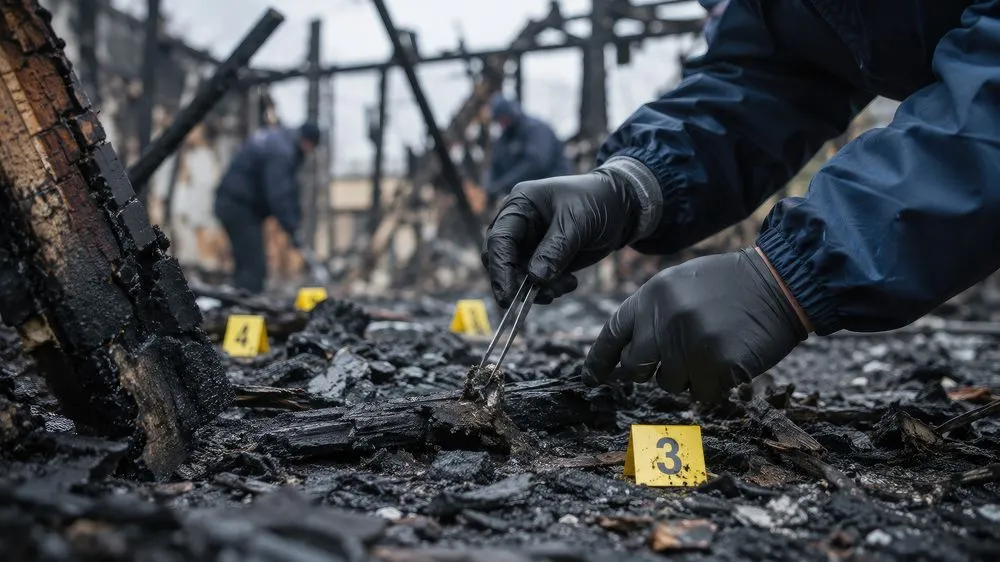
Origin comes first, because a cause is only credible if the proposed ignition source was actually at the origin. Investigators determine origin from several kinds of information. They use the fire effects and patterns left on the structure and contents, accounts from witnesses and first responders, and an understanding of how fire grows and spreads in a room or building.
The 2021 edition of NFPA 921 rewrote its treatment of fire effects and patterns. It now defines fire effects as observable or measurable changes in four categories: discoloration, deformation, deposition, and mass loss. It also treats arc mapping, which is locating the points where energized electrical circuits arced during the fire, as a fire pattern. (See this summary of the 2021 changes.)
Step Two: Determining the Cause
With the origin established, the investigator identifies the competent ignition sources present there and the materials that could have been ignited first. Each possible cause becomes a hypothesis that has to explain the facts. That means the ignition source, the first fuel, and the circumstances that brought them together, whether that was a failed component, an improper installation, a misuse, or a deliberate act.
Many cause hypotheses depend on how a building system or product behaves. Did this circuit have a fault? Could this appliance reach ignition temperature? Did this gas control fail open? Answering those questions is engineering. That is why a fire investigation is often strongest when the scene investigator works with a qualified engineer, and the hypotheses are tested against both the physical evidence and the engineering analysis.
Why Negative Corpus Fails
Negative corpus is the practice of eliminating every accidental cause an investigator can identify and then concluding, without direct evidence, that the fire must have been set. Beginning with the 2011 edition, NFPA 921 has rejected negative corpus as inconsistent with the scientific method.
The reasoning is simple. Not finding evidence of an accidental cause is not evidence of a deliberate one. The investigator may have missed something, or the evidence may have been destroyed. A cause determination needs affirmative evidence of how the fire was ignited. Opinions built on elimination alone are a common target in court challenges to fire experts.
When the Answer Is “Undetermined”
Sometimes no hypothesis survives testing. The evidence may be too damaged, two possible causes may remain equally consistent with the facts, or critical evidence may have been lost. In that case the scientifically honest conclusion is that the cause is undetermined. That is a legitimate result, and far more defensible than a cause the evidence cannot carry. An undetermined cause can still come with a well-supported origin, and with specific causes that have been excluded.
Classifying a fire is a separate question from determining its origin and cause. Labels such as accidental, natural, or incendiary are often used for reporting and administrative purposes. The 2021 edition of NFPA 921 removed its chapter on fire classification. The investigator's core findings are the origin, the cause, and how strongly the evidence supports each one.
Where Origin-and-Cause Investigations Go Wrong
- Deciding the cause too early and then gathering only the evidence that supports it.
- Skipping a defensible origin and jumping straight to a cause.
- Relying on negative corpus rather than affirmative evidence of ignition.
- Not testing alternative hypotheses that another expert will raise.
- Losing or altering evidence before other parties could examine it, which can lead to spoliation sanctions.
- Going beyond the investigator's expertise on engineering questions without qualified support.
Preserving evidence is the foundation for everything else. See The First 72 Hours After a Fire or Explosion for the steps that protect it. For how courts evaluate expert methodology, see Surviving a Daubert Challenge.
How LaRovere Approaches Origin and Cause
LaRovere's fire investigations follow the scientific method set out in NFPA 921. Hypotheses are developed from the evidence, tested against it, and excluded and documented as excluded when the evidence does not support them. Scene work is led by Justin Weller, who brings 13+ years in Arizona law enforcement and eight years in the fire service, with more than 1,200 documented hours of fire, explosives, and related technical training. Where the cause may involve a building system, the firm's licensed Professional Engineers analyze the electrical, mechanical, gas, and HVAC questions directly.
Frequently Asked Questions
What is NFPA 921?
NFPA 921, the Guide for Fire and Explosion Investigations, is published by the National Fire Protection Association. It sets out a systematic approach to investigating fires and explosions, based on the scientific method. Fire investigators, insurers, attorneys, and courts widely treat it as the benchmark for a reliable investigation. Investigators are routinely asked in depositions and at trial whether they followed it. NFPA revises the guide periodically, so the edition in effect at the time of the investigation matters.
What is the difference between fire origin and fire cause?
The origin is where the fire started, the area or point where ignition occurred. The cause is why it started. That means identifying the ignition source, the first material ignited, and the circumstances that brought them together. Origin is determined first, because a cause is only credible if the proposed ignition source was present at the origin. An investigation that skips a defensible origin determination usually cannot support a reliable cause.
What is negative corpus, and why does NFPA 921 reject it?
Negative corpus is the practice of ruling out every accidental cause an investigator can think of, then concluding the fire was set, without evidence of how it was ignited. Beginning with the 2011 edition, NFPA 921 rejects it as inconsistent with the scientific method. Ruling out other causes is not proof of the one left over. A cause determination needs affirmative evidence of an ignition source, a first fuel, and the circumstances that brought them together.
Can the cause of a fire be undetermined?
Yes. If no hypothesis survives testing against the evidence, the scientifically honest conclusion is that the cause is undetermined. That is a legitimate finding, not a failure. It is more defensible than a cause the evidence cannot support. An undetermined cause can still allow some possibilities to be excluded, and it can identify the origin, which may itself be significant to the parties.
How is a fire investigator's opinion challenged in court?
Opposing counsel usually tests whether the investigator followed a reliable methodology and applied it to the facts. That typically means asking whether NFPA 921's scientific method was used, and whether every alternative hypothesis was properly tested. They also probe whether the conclusion relied on negative corpus, and whether evidence was preserved and the other parties had a chance to examine it. Opinions that cannot show that process are vulnerable to exclusion under Daubert or similar standards.

About the Author
Justin Weller brings 13+ years in Arizona law enforcement and eight years in the fire service to LaRovere's fire and explosion investigations. He has more than 1,200 documented hours of fire, explosives, and related technical training, and holds Firefighter I and II and Fire Instructor I certification through the Arizona State Fire Marshal's Office.
Read Justin's full profile →